
Analyzing Dual-Threat NFL Quarterback Rushing Props
 Available in US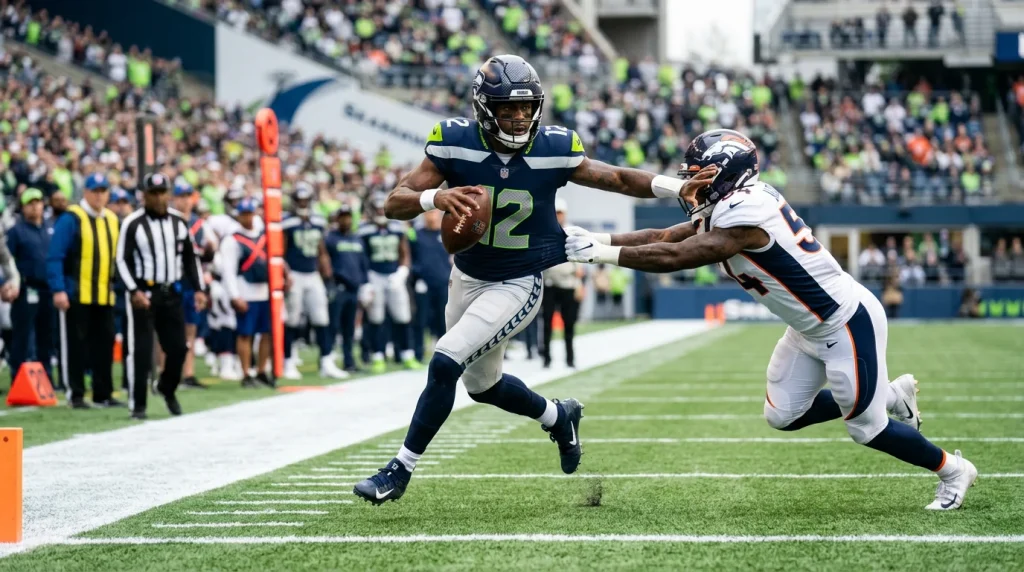
I watched Lamar Jackson rush for 117 yards on a Monday night in 2023 and thought I had discovered the easiest money in sports betting. Quarterback rushing props, I decided, were the ultimate inefficiency — bookmakers set the lines too low, the overs cashed week after week, and nobody was paying attention. Two weeks later, I took a rushing over on a mobile quarterback who ran three times for 8 yards and spent the evening handing off to his running backs. That night cost me the previous month’s profits and taught me the essential lesson of quarterback rushing props: the variance is enormous, and the edge only exists if you understand what triggers a quarterback to run.
Quarterback rushing yards represent the fastest-growing segment of the NFL prop market. The proliferation of dual-threat quarterbacks — players who can hurt defences with their legs as much as their arms — has forced bookmakers to offer lines they historically did not, creating a market segment where pricing is still evolving and edges are more accessible than in the mature passing yards space.
Rushing Classification – Separating Scrambles from Designed Runs
Not all quarterback rushing yards are created equal, and failing to distinguish the two sources of those yards is the most common mistake in this market.
Designed runs are plays where the quarterback is intended to carry the ball from the snap. These are scheme-driven, predictable in volume (though not in outcome), and show up consistently in a team’s play-calling tendencies. A quarterback who averages six designed runs per game will see that number stay relatively stable from week to week because it reflects the offensive coordinator’s philosophy, not the chaos of the moment. Designed runs produce the reliable floor of a quarterback’s rushing output.
Scrambles are reactive. The quarterback drops back to pass, the pocket collapses or no receiver opens, and he takes off running. Scramble yards are unpredictable — they depend on the pass rush pressure from the opposing defence, the coverage downfield, and the quarterback’s instinct in the moment. A quarterback might scramble five times for 45 yards one week and zero times the next against a defence that provides a clean pocket.
When I evaluate a quarterback rushing prop, I separate these two components. I estimate the expected designed run volume using the team’s play-calling data over the past three weeks, then add a scramble estimate based on the opposing defence’s pressure rate. A defence that pressures the quarterback on 35% or more of dropbacks creates more scramble opportunities. A defence that barely gets pressure reduces scramble yardage to near zero, leaving only the designed runs to carry the prop.
Which Defences Invite Quarterback Runs
There is a counter-intuitive truth about quarterback rushing props: the best defences against the run are not necessarily the worst for quarterback rushing lines. A defence might shut down running backs completely but leave wide lanes for a scrambling quarterback because its aggressive pass rush creates escape routes when a blocker is beaten.
I track two defensive metrics for quarterback rushing props. The first is the defence’s sack rate — specifically, how often they convert pressures into actual sacks. A high-pressure, low-sack defence is the ideal opponent for a mobile quarterback, because the pressure forces scramble situations but the defence cannot finish the play. The quarterback escapes and runs. A high-pressure, high-sack defence is the worst matchup, because the quarterback gets hit before he can take off. The distinction matters hugely.
The second metric is the defence’s tendency to play man coverage versus zone. Man coverage takes defenders’ eyes away from the quarterback after the snap — they turn their backs to chase their assigned receivers. A quarterback who sees man coverage recognises that nobody is watching him and takes off into the vacated space. Zone coverage keeps defenders facing the quarterback, which allows them to react to scrambles earlier and limits the yardage gained. With 290 million online bets placed monthly across UK platforms, the punters who track this kind of granular defensive tendency have a genuine informational edge over the majority who simply look at “rushing yards allowed.”
The Injury and Fatigue Angle
A colleague of mine keeps a spreadsheet tracking every time a mobile quarterback appears on the injury report with an ankle, knee, or foot designation. His finding, tracked over four seasons, is striking: quarterbacks with lower-body injury designations see their rushing attempts drop by roughly 30-40% compared to when they are fully healthy, even when they play. The coaching staff protects them. Designed runs disappear from the game plan, scrambles become shorter as the quarterback slides earlier, and the rushing ceiling collapses.
This creates the clearest under signal in the quarterback rushing market. A dual-threat quarterback who is “questionable” with an ankle issue and still plays is almost certainly being managed. His rushing line, if set near his season average, does not reflect the reduced role. The under becomes the obvious play.
Fatigue operates on a longer timeline. The NFL season grinds down running quarterbacks over 17 games. A quarterback who rushed for 60 yards per game in September might average 35 by December, not because defences adjusted but because his body cannot sustain the punishment. I compare early-season and late-season rushing averages for every mobile quarterback and adjust my expectations accordingly. The market sometimes prices late-season games using full-season averages that overweight the early games, creating value on the under side as the year progresses.
Game Script and Quarterback Rushing Volume
You would think a trailing team would see its quarterback run more — desperation and all that. The opposite is true. When a team falls behind, the offensive game plan shifts to passing to catch up quickly. Designed quarterback runs are abandoned because they keep the clock running and do not gain yards fast enough to erase a deficit. Scrambles might increase slightly as the quarterback faces more pressure in obvious passing situations, but the net effect is usually fewer rushing yards, not more.
The best game scripts for quarterback rushing are tight games or games where the quarterback’s team leads by a modest margin. In those situations, the offensive coordinator feels comfortable calling designed runs to maintain ball control and keep the defence honest. The quarterback’s rushing volume stays at or above his baseline because there is no urgency to abandon the run game.
Blowouts — whether leading or trailing — suppress quarterback rushing. A team ahead by 20 pulls its mobile quarterback’s designed runs to avoid injury risk. A team behind by 20 throws every down. The spread, as with so many prop markets, is your pre-game guide. Games projected within a touchdown spread are the best environment for quarterback rushing overs. Games projected as blowouts — spreads of 10 or more points — tilt the market toward the under regardless of the quarterback’s rushing talent.
Line Shopping and the Value of Small Differences
Quarterback rushing lines vary more across bookmakers than any other major prop category. I have seen the same quarterback listed at 34.5 rushing yards on one platform and 42.5 on another in the same week. That 8-yard gap is enormous when you consider that the entire prop range for most rushing quarterbacks falls between 25 and 55 yards.
The variation exists because bookmakers model quarterback rushing differently. Some use season-long averages weighted toward recent performance. Others build game-specific projections that account for the opposing defence’s tendency. Still others adjust based on betting volume, moving their lines in response to where the money flows. The result is a market where shopping across two or three platforms before placing your bet routinely finds you an extra 3-5 yards of line value. Over a full season of quarterback rushing props, that difference compounds into a meaningful edge.
For UK bettors specifically, the platforms offering NFL quarterback rushing props have expanded significantly. Prop bet growth across the market has exceeded 60% year on year, and quarterback rushing is one of the categories that has driven that expansion. The competition between platforms for your action means better lines and more options — but only if you take the time to compare before clicking. For a broader look at how game environment shapes all rushing props, my rushing yards evaluation guide covers the full running back market alongside the quarterback rushing niche.
Why are quarterback rushing props so volatile compared to passing props?
Quarterback rushing yards come from two sources — designed runs and scrambles — and scrambles are inherently unpredictable. A quarterback might scramble five times one week and zero times the next depending on the opposing pass rush and coverage. This dual-source structure creates wider variance than passing yards, which are driven by a more consistent volume of attempts each game.
Should I avoid quarterback rushing overs when the QB is on the injury report?
Lower-body injuries — ankle, knee, or foot — significantly reduce quarterback rushing attempts even when the player starts the game. Coaching staffs limit designed runs and the quarterback tends to slide earlier on scrambles. If the rushing line is set near the season average rather than accounting for the reduced role, the under is usually the stronger side.
Articles
Written by the editors at NFL Player Betting.
