
NFL London Neutral Venue Dynamics and Travel Analysis
 Available in US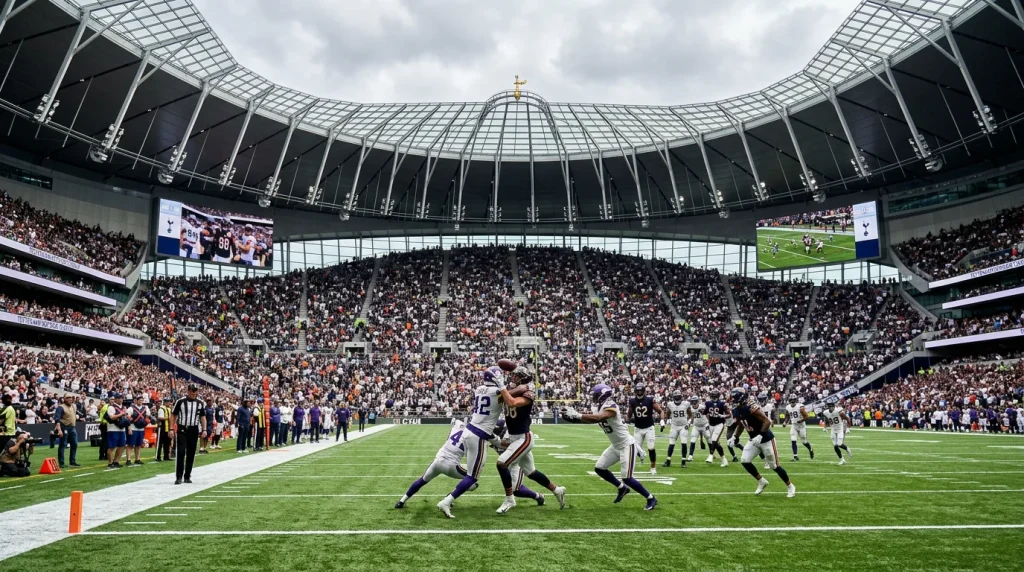
I was at Tottenham Hotspur Stadium for a London game in 2022 when something struck me that changed how I bet these fixtures. Both teams looked off. Not bad — just slightly sluggish, slightly mistimed. Routes were a half-step late, blitz pickups were confused, and the tempo dragged in a way that regular-season games at home stadiums rarely do. That observation sent me into the data, and what I found confirmed what my eyes were telling me: London games are not normal NFL games, and betting them as if they are is leaving value on the table.
The NFL has staged 39 games in London since 2007. That is a meaningful sample — not enormous, but large enough to identify patterns that do not appear in single-season snapshots. For UK punters, these games are the one moment each year when the NFL plays on home soil, and the betting interest spikes accordingly. The trick is converting that interest into an edge rather than an emotional bet.
Historical Trends – Analyzing 39 Games of London Data
Jamie Reynolds, a UK-based sports marketing consultant, once described how British fans are less tribal than American ones — a team’s global profile and those magical first Wembley or Tottenham experiences often stick with fans for life. That fan dynamic creates a unique atmosphere, but it also creates a unique betting environment.
The aggregate data from 39 London games reveals several patterns. Scoring tends to run slightly below the regular-season average, driven by lower offensive efficiency in the first half. Both teams are operating outside their normal environment — different practice facilities, different sleep schedules, different pregame routines — and the adjustment period shows up in the stats. First-half passing yards are the most visibly affected metric, with quarterbacks completing a lower percentage of their attempts in the opening two quarters compared to their season averages.
The second half tells a different story. By the third quarter, offences settle in and the pace normalises. Some games even see a second-half scoring explosion as teams that struggled early find their rhythm and press the accelerator. This first-half drag and second-half recovery pattern has implications for live prop betting: first-half unders have historically carried a slight edge in London games, while full-game totals are closer to fair.
Attendance at Wembley has consistently hit approximately 86,000, while Tottenham Hotspur Stadium fills to its roughly 61,000 capacity. Both venues sell out, confirming sustained demand. The atmosphere is electric but the crowd dynamic is different from a US home game. There is no true home-field advantage — the noise is loud but neutral, and neither team benefits from the crowd energy that typically lifts the home side. For prop purposes, this neutrality means you can strip home-field adjustments out of your model entirely. Neither team gets a boost; both are equally displaced.
Travel Fatigue and Jet Lag: How They Show Up in Player Props
I tracked something specific over the last four seasons of London games: the performance of players who arrived in the UK fewer than five days before kickoff versus those whose teams flew in a week early. The difference was not dramatic, but it was consistent. Early arrivals showed stat lines closer to their season baselines, while late arrivals showed a 5-8% dip in first-half production metrics.
Jet lag is real. A five-hour time shift — eight hours for West Coast teams — disrupts sleep patterns, reaction time, and cognitive processing. Quarterbacks are most affected because their position demands the fastest decision-making. A quarterback who normally releases the ball in 2.6 seconds might hold it an extra fraction in London, leading to more sacks and fewer completions. That fraction does not sound like much until you realise it compounds across 30-40 dropbacks per game.
Running backs and receivers are less directly affected by cognitive lag but more affected by the physical dimension. Muscles that are not fully recovered from disrupted sleep do not generate the same explosive power, and the data shows a marginal decline in yards after contact for running backs and yards after catch for receivers in London games compared to their seasonal norms.
For prop betting, the travel angle is most valuable when one team has a clear logistical advantage. If Team A flew to London on Monday and practised all week at a local facility while Team B arrived on Thursday after a West Coast departure, the asymmetry is significant. I apply a small discount to the late-arriving team’s offensive props — particularly first-half props — and look for value on the early-arriving team’s defensive markets if the book has not adjusted.
The Kansas City Chiefs, the most popular NFL team in the UK with roughly 9.5% of British NFL search traffic, have played in London multiple times, and their performance data in these games is worth isolating. Star-studded teams attract more public betting action in London fixtures, which can inflate their player prop lines beyond what the matchup and travel logistics justify. When the public overloads one side, the other side becomes relatively underpriced — a pattern that plays out more visibly in London games than in standard US fixtures because of the heightened casual interest.
Neutral Venue Dynamics and Crowd Composition at Wembley and Tottenham
Walk into a London NFL game and you will see something you never see at an American stadium: fans wearing jerseys from both teams sitting side by side, mixed in with supporters of teams not even playing. The crowd is there for the spectacle, not for partisan support, and that changes the acoustic environment in ways that affect gameplay.
In a typical NFL home game, the crowd noise peaks on third downs when the visiting offence is trying to communicate. That noise disrupts snap counts, forces silent counts, and leads to false start penalties and miscommunications. In London, the noise is more evenly distributed — loud during big plays for either team, quiet during routine sequences. The result is that visiting-team penalties, which spike in hostile US road environments, drop to near-baseline levels in London. Both teams operate in something closer to a controlled environment.
For player props, the neutral crowd means you can ignore the home/away adjustment that normally affects offensive efficiency. A quarterback who typically struggles in road environments — lower completion percentage, more interceptions, fewer yards — does not face the same hostile conditions in London. His London prop should be priced closer to his home performance than his road performance, and if the book uses a simple home/away split to set the line, there may be value on the over.
The venue itself matters too. Tottenham Hotspur Stadium was purpose-designed with an NFL-specification pitch, including a retractable grass surface. The playing surface is excellent and consistent. Wembley, while a world-class venue, has historically drawn complaints about the pitch quality late in the football calendar when the turf has been heavily used. Surface conditions affect rushing props more than passing props — a softer, cut-up pitch reduces traction and explosive play, which suppresses rushing yards and long runs. If your prop strategy leans heavily on rushing markets, the specific venue and its recent pitch condition are worth a few minutes of research before kickoff. I covered how surface and environmental factors shape player stats more broadly in my live betting strategy guide.
Do NFL teams travelling to London typically underperform on player stats?
The data from 39 London games shows a slight decline in first-half offensive production for both teams, with passing efficiency most visibly affected. By the second half, performance generally normalises. Teams that arrive in London early and have a full week of local practice tend to perform closer to their season baselines than teams arriving later in the week.
Which London venue — Wembley or Tottenham — produces higher-scoring games?
The sample sizes per venue are not large enough to draw a definitive conclusion. However, Tottenham Hotspur Stadium"s purpose-built NFL pitch generally provides a better playing surface, which can support more explosive offensive plays. Wembley"s larger capacity creates a different atmosphere but has occasionally drawn concerns about pitch quality later in the calendar year. Neither venue consistently produces significantly higher or lower scoring than the other.
Articles
Published by the NFL Player Betting team.
