
UK NFL Live Betting and In-Play Player Props
 Available in US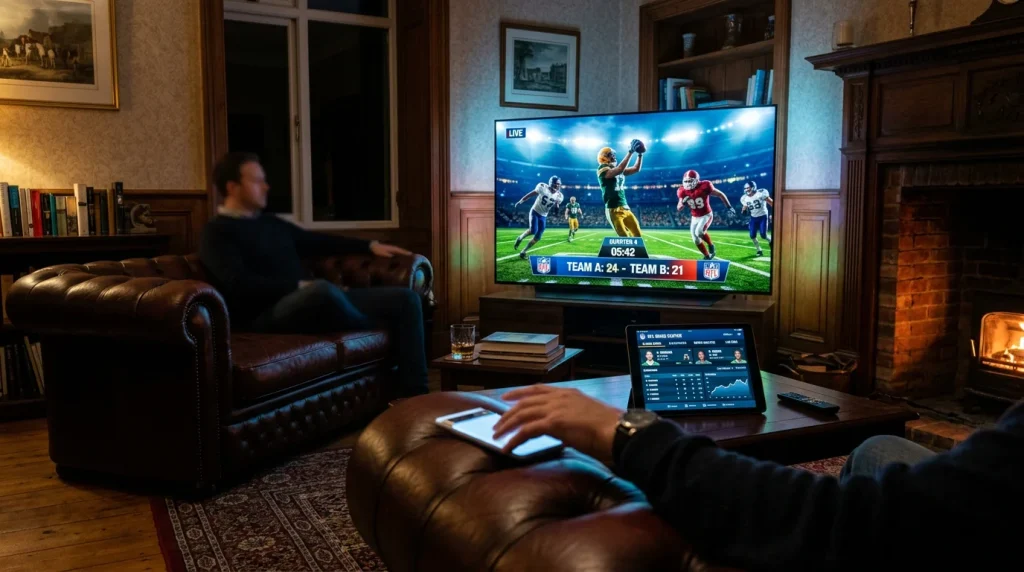
The best prop bet I ever placed happened in the third quarter of a Thursday Night Football game I was watching from my sofa in south London. The starting running back had taken a big hit on a second-down carry, limped to the sideline and was listed as questionable. Within ninety seconds, his rushing yards line dropped from 62.5 to 44.5 on the live market, but I had already seen him stretching on the bench, chatting with the trainer and testing his weight on both legs. He was coming back. I hit the under at the pre-injury line and the over at the new one — hedged perfectly — and the back jogged onto the field two drives later to finish with 71 yards. That is in-play betting at its best: real information, faster than the algorithm, acted upon in the moment.
Live betting is not a niche anymore. In-play wagers now account for 62.35% of the entire UK online betting market, and that share keeps growing every quarter. The NFL, with its stop-start rhythm of huddles, timeouts, two-minute warnings and quarter breaks, is almost uniquely suited to in-play wagering. Every pause is a window. Every substitution is a data point. Every injury timeout is a market dislocation waiting to happen.
This article breaks down how live player prop markets actually function during an NFL broadcast, when the value appears, when to cash out and when to let your position ride, and how to avoid the specific traps that catch in-play bettors who trade on impulse rather than information. I have been betting NFL props in-play for eight seasons, and the lessons here come from watching thousands of quarters of football with a bet slip open on my phone.
In-play wagering becomes much more profitable when you analyze how the NFL game script affects player props during the second half.
Market Mechanics – Navigating Live NFL Prop Fluctuation
I used to assume live player prop markets worked like pre-game markets with updated numbers. They do not. The mechanics are fundamentally different, and understanding those differences is the first step to finding value in-play.
Pre-game player props are set by human traders using statistical models, injury reports, weather data and historical matchup analysis. The lines are published hours or even days before kickoff, and they sit there absorbing money from both sides until the game starts. Live props, by contrast, are driven primarily by algorithms that ingest play-by-play data in real time and recalculate probabilities after every snap. A human trader still oversees the process, but the speed of adjustment is machine-driven. When a quarterback completes a forty-yard pass, his passing yards line shifts within seconds — not because a person recalculated, but because the model updated its projection based on his current pace, remaining game time and historical completion patterns in similar game states.
Live prop markets open at kickoff and stay active through most of the game, but they do not stay open continuously. Bookmakers suspend markets during active plays — the window closes when the ball is snapped and reopens when the play is whistled dead and the data feed updates. In practice, this means you have roughly twenty to thirty seconds between plays to assess the new information, check the updated line and decide whether to act. That sounds tight, but NFL games average around 130 to 140 plays, so you get plenty of decision windows across four quarters.
Markets also close permanently at different points depending on the prop type. A first-half passing yards prop obviously closes at halftime. A full-game rushing yards prop might stay open into the fourth quarter, but most bookmakers close it once the outcome becomes near-certain — when a running back needs 40 yards to hit the over with two minutes left and his team is in victory formation, the market shuts. Anytime touchdown scorer props behave differently again: they remain open as long as the player is on the field and the game is competitive, but they close if the player is ruled out or if the score becomes so lopsided that meaningful offensive snaps are unlikely.
The key insight is that live markets are not just updated pre-game markets. They are a different product with different pricing, different margin structures and different information asymmetries. The bookmaker’s algorithm is fast but formulaic. It reacts to what has happened. You, watching the broadcast, can sometimes see what is about to happen — a formation change, a personnel grouping, a coaching tendency in a specific game situation — and that forward-looking edge is where live prop value lives.
UK Kickoff Times and the In-Play Window: Betting at 18:00 and 21:25
Here is something most American betting guides never mention: time zones change everything about how you experience live NFL betting. The early Sunday slate kicks off at 18:00 UK time. The afternoon games start at 21:25. Sunday Night Football begins after 01:00 on Monday morning, and Monday Night Football follows the same pattern a day later. Thursday Night Football hits at 01:15 on Friday. Your in-play betting strategy has to account for when you are actually awake, alert and capable of making sharp decisions.
The 18:00 Sunday window is the sweet spot for UK bettors. You have had your weekend, you are settled in, and you are watching the early games with full concentration. This is when I do the majority of my live prop betting. Multiple games running simultaneously means multiple markets open at once, and the sheer volume of action across the league creates pricing inefficiencies. A bookmaker’s algorithm might be perfectly calibrated for a standalone prime-time game, but when eight games are running simultaneously and injury news is breaking across three of them, the models cannot adjust every market instantly. That lag is your edge.
The 21:25 games are still workable. You are four hours into your football evening, which means fatigue is a factor — both for you and for the casual bettors whose money shapes the market. I have noticed that live prop lines in late-afternoon games tend to be slightly sharper because the recreational volume drops off as the evening wears on. The dedicated bettors who remain are more informed, which means the bookmaker’s lines face more educated pressure and the obvious mispricings get snapped up faster.
The late-night and early-morning kickoffs — Sunday Night, Monday Night, Thursday Night — are a different calculation entirely. Sixty-eight per cent of UK NFL fans are aged 18 to 44, and a meaningful chunk of that demographic has work on Monday or Friday morning. Betting at 01:00 while fighting sleep is a recipe for impulsive decisions. I learned this the hard way during my second season of in-play betting, when I chased a bad third-quarter prop at 02:30 on a Monday morning and woke up to a depleted balance. My rule now is simple: if the game kicks off after midnight UK time, I set my positions pre-game and do not touch the live markets. The discipline costs me the occasional late-night value play, but it saves me from the far more frequent late-night mistake.
Four In-Play Scenarios Where Player Prop Value Appears
Not every moment in a football game produces live prop value. Most of the time, the algorithm is doing its job correctly and the live lines reflect reality. But there are four recurring scenarios where the market consistently lags behind what an attentive viewer can see on screen, and these are the situations I wait for every Sunday.
Scenario one: the early-game script divergence. A team expected to lean on the run game falls behind by ten points in the first quarter and abandons the ground attack entirely. The quarterback’s passing yards line was set pre-game with the assumption of a balanced game script, but the live model is slow to fully adjust because it weights historical pace against current pace. If the quarterback is averaging nine yards per attempt through the first quarter and the team is clearly going pass-heavy for the rest of the game, the live passing yards over often holds value for a window of two or three drives before the algorithm catches up. I look for this specifically in games where the pre-game spread was close — three points or fewer — because those are the games where the models assumed a competitive, balanced contest and the actual game has diverged sharply.
Scenario two: the backup enters the game. When a starting quarterback gets injured and the backup takes over, every skill-position prop on that offence resets. The live algorithm adjusts the quarterback’s own props quickly, but it is slower to recalibrate the wide receivers and running backs. A backup quarterback typically throws shorter, checks down more frequently and leans on one or two familiar targets. If you know who the backup’s preferred receiver is — and this is publicly available information from training camp reports and preseason snap counts — you can often find value on that receiver’s receptions or targets prop before the market adjusts. The inverse applies too: the wide receiver who was the starter’s deep threat suddenly becomes far less likely to hit his yardage over with a weaker arm throwing the ball.
Scenario three: the weather shift. NFL games are played outdoors in stadiums across the country, and conditions change during a three-hour broadcast. Wind picks up, rain starts, temperature drops. The 2025 NFL season averaged roughly 18.6 million viewers per game — an eight per cent increase over 2024 — and those viewers see the weather on screen before the data feed registers it. A passing yards line that was set in calm conditions does not immediately adjust when the wind flags start whipping on the telecast. I have hit profitable live unders on passing props simply by watching the sideline shots and noticing that the kicking net was blowing sideways during warm-ups for the second half.
Scenario four: the garbage-time accumulation. A game is effectively over with a 28-7 scoreline in the fourth quarter, and the trailing team’s quarterback is throwing against a prevent defence. His passing yards and completions are piling up at an accelerated rate, but the yards are meaningless in terms of winning the game. The live algorithm tracks the pace without fully discounting the context. If the quarterback needs 40 more yards to hit his full-game over and the defence is sitting in a soft zone designed to prevent touchdowns rather than completions, the over can be a strong play at reduced odds. The game script and player props breakdownexplores these dynamics in more depth, but in the live context, the window to act on garbage-time value is narrow — usually two or three drives before the starters are pulled entirely.
Cash-Out Timing on Live Props: When to Lock In and When to Let It Ride
Cash-out buttons are the most psychologically dangerous feature on any betting app, and in live NFL prop betting they appear at precisely the moments when your emotions are running highest. I have a framework for when to use them and when to ignore them, developed through years of getting it wrong.
The first principle: never cash out based on fear alone. If your pre-game analysis said a wide receiver would clear 65.5 receiving yards and he has 42 at halftime on seven targets, the thesis is intact. A slow first half does not invalidate the research that led you to the bet. The cash-out offer at halftime reflects the algorithm’s updated probability, which is lower than when you placed the bet, so the offer will always feel disappointing relative to your potential payout. Taking it means accepting a loss on expected value in exchange for emotional relief. That is a bad trade in most situations.
The second principle: always cash out when your thesis breaks. If you bet the over on a running back’s rushing yards because you expected a positive game script and his team is now trailing by twenty-one points, the game script has collapsed. The team will abandon the run. Your thesis is dead. The cash-out offer might be twenty per cent of your stake, but twenty per cent is better than zero. The mistake people make is holding on because “anything can happen” — and while that is technically true, you placed the bet based on a specific prediction about how the game would unfold, and that prediction was wrong. Accept the loss and move on.
The third principle: use partial cash-out to manage variance on parlay legs. If you have a live SGP with three legs and two have already landed, you can often cash out a portion of the position to guarantee a profit while leaving the rest to ride on the final leg. This is especially useful in the fourth quarter when the remaining leg is a yardage prop that is close to the line. Locking in sixty per cent of the potential payout and letting forty per cent ride is a perfectly rational middle ground between greed and caution.
The fourth principle: check the cash-out value against your own probability estimate. If the bookmaker offers you a cash-out that implies a forty per cent chance of your bet winning, but you believe the true probability is sixty per cent based on what you are watching, decline the cash-out. You are being offered a bad price. Conversely, if the cash-out implies seventy per cent and you think it is closer to fifty, take it. The cash-out button is just another bet — treat it like one.
Real-Time Data Sources for UK NFL Live Bettors
When I started live-betting NFL props, my only data source was the broadcast itself. Now I have three screens running during the Sunday slate, and the gap between informed and uninformed live bettors has never been wider. Here is what I use and why each source matters.
The broadcast is still your primary feed — not for statistics, but for context. Camera angles show you things the data feed misses: a quarterback shaking his throwing hand after a hit, a receiver limping back to the huddle without being flagged as injured, a coaching staff huddled around a tablet suggesting a scheme adjustment. These visual cues precede the official injury report and the statistical update by thirty to sixty seconds, and in live betting, thirty seconds is an eternity.
Real-time box score trackers are your second layer. Several free services update NFL play-by-play data within five to ten seconds of each snap. I keep a tracker open alongside the broadcast to monitor yardage pace, target distribution, snap counts and drive efficiency. The tracker tells me that a wide receiver has been on the field for thirty-two of thirty-five offensive snaps and has seen eleven targets through three quarters. The broadcast tells me that the defensive back covering him just got beaten badly on a double move but the pass was overthrown. Together, those two data points suggest the over on his receiving yards is still live despite the missed connection.
Social media, used carefully, is the third source. Beat reporters at NFL stadiums often tweet injury observations, warm-up notes and sideline activity before the broadcast cuts to a relevant camera angle. The signal-to-noise ratio is terrible — most football Twitter is reactions and opinions — but a curated list of credible reporters for the teams you are betting on can give you a fifteen-to-twenty-second information edge on substitutions and injury updates.
The infrastructure enabling all of this real-time data is driven by the same investment that fuels the broader sports betting industry. Jason Robins, the DraftKings chief executive, noted that his company’s fourth-quarter revenue rose 43% year over year as the platform expanded its real-time offering. That kind of growth attracts capital, and capital funds faster data feeds, more granular tracking and better in-play products for bettors on both sides of the Atlantic. UK bettors benefit directly: the technology built for the American market flows into the platforms licensed here, giving you access to the same data infrastructure without needing a US-based account.
Stay ahead of the oddsmakers with the real-time data provided by our expert NFL betting strategy guide.
Risks of Live NFL Prop Betting: Latency, Emotion and Thin Markets
I would be doing you a disservice if I painted live prop betting as pure opportunity without acknowledging the risks that are specific to in-play wagering. Three of them deserve serious attention.
Latency is the invisible tax on live bettors. The data you see on your screen — the broadcast, the play-by-play tracker, even the bookmaker’s own odds feed — is delayed by anywhere from three to fifteen seconds depending on the source. The bookmaker’s algorithm, meanwhile, ingests data directly from the official play-by-play feed with minimal delay. This means there are moments when you think you are acting on fresh information, but the line has already moved to reflect it. The practical impact is that you occasionally place a bet at what you believe is the current price, only to have the bookmaker reject it or offer you worse odds because the market shifted during the processing window. I budget for this by treating any live bet as having a one-to-two-point margin of error — if the value only exists at the exact posted line, it is not worth the latency risk.
Emotional escalation is the second danger. Live betting during a game you are watching is immersive in a way that pre-game betting is not. Every big play triggers a reaction, and that reaction can bypass your analytical framework entirely. A quarterback throws an interception, his passing yards line drops, and your gut screams “buy the dip” before your brain has processed whether the interception was a fluke or a sign that the quarterback is struggling. I limit myself to a maximum of three live prop bets per game for exactly this reason. The cap forces me to be selective rather than reactive.
Thin markets are the third risk. Not every player prop stays open in-play, and the ones that do often have wider margins than their pre-game equivalents. A backup tight end’s receiving yards prop might be available pre-game at a two-yard spread between the over and under lines, but the in-play version — if it exists at all — might carry a four-to-six-yard spread. That wider margin eats into your edge. Since October 2025, UK bookmakers are required to offer customers the option to set financial limits before their first deposit, and I would strongly encourage using those tools for live betting specifically. The pace and excitement of in-play wagering make it easier to overspend than any other form of betting, and having a hard limit in place before the game starts removes the temptation to chase losses in the fourth quarter.
Frequently Asked Questions About NFL Live Betting in the UK
Are live NFL player props available on all UK bookmaker apps?
Not all UK bookmakers offer live player props for NFL games. The major licensed platforms with dedicated NFL coverage typically provide in-play markets for passing, rushing and receiving yards as well as touchdown scorer props. Smaller operators may only offer live game-level markets like the moneyline, spread and total without individual player props. Availability also depends on the specific game — prime-time fixtures like Sunday Night Football and Monday Night Football usually have fuller live prop menus than early-window games with lower viewership. Check your bookmaker"s in-play section during a game to see exactly which props are offered.
How quickly do in-play prop lines update during an NFL game?
Live prop lines typically update within five to fifteen seconds after each play is recorded in the official data feed. During active plays the markets are suspended, then they reopen with adjusted lines once the play result is confirmed. The speed varies by bookmaker and by market type — popular props like quarterback passing yards update faster than niche props like a defensive player"s tackle count. Between plays you usually have a window of twenty to thirty seconds to review the updated lines and place a bet before the next snap.
Can I combine live player props into a same game parlay?
Some UK bookmakers allow you to add live props to a bet builder or same game parlay during the game, but the functionality is not universal. Platforms that do offer live SGPs typically limit which markets can be combined and may restrict the number of legs. The correlation adjustments on live SGPs tend to be more aggressive than on pre-game versions because the algorithm has less certainty about outcomes mid-game. If live SGPs are important to your strategy, test the feature during early-season games to understand which platforms support it and how the pricing compares to pre-game bet builders.
What happens to a live prop bet if the game goes to overtime?
If an NFL game goes to overtime, most player prop bets include the overtime period in the final statistics unless the prop specifically states it covers regulation time only. A quarterback"s passing yards over of 250.5 counts every yard thrown in overtime toward the total. The same applies to rushing yards, receiving yards and touchdown scorer props. Check the specific settlement rules on your bookmaker"s platform, as these can vary slightly between operators. Overtime adds an extra dimension to live betting because the sudden-death format in the playoffs or the modified overtime rules in the regular season can create sharp movements in prop lines.
Articles
Published by the NFL Player Betting team.
